Integration as a Service

Integration as a Service

Integration as a Service

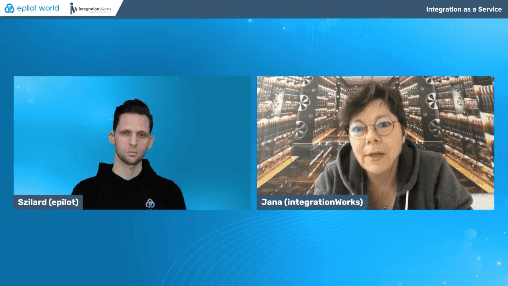
Interviewed at ePilot World 2022 for integrationWorks GmbH, Germany on the topic of Integration as a Service.

Integration is the enabler for your transformation. Like ePilot as a front-end system for energy providers. ePilot provides a customer-friendly and modern system for its end users. Connect it with your in-house backend systems or other cloud-based SaaS applications such as your CRM.

At the same time, the modernization of the application landscape can be planned and implemented step by step without negative side effects for customers and partners. But also by connecting your DataLake architecture and enriching it with further environment-specific information for the analysis of potential customer requirements for the provision of new services can be realized easily and quickly e.g. with the help of integration platforms like Boomi. By directly connecting marketing, sales, and operations, services around your customers can be further optimized.

Curious now: Just have a look at the video or contact me, or integrationWorks GmbH directly.

Tamacoinchi & Co – Students Pitch Their Blockchain Projects

Tamacoinchi & Co – Students Pitch Their Blockchain Projects

It’s time for a new kind of energy! A debut took place this summer semester with the course “Blockchain with Ethereum & Solidity” led by Jana Bulkin. Twenty-five students from the Faculty of Computer Science and Mathematics at Munich University of Applied Sciences first became familiar with the theoretical basics of the topic. Later they were able to develop their own projects in small groups based on real-life conditions with the help of state-of-the-art tools.

Blockchain? What is that about?

Briefly explained for non-IT people: Basically, a blockchain is an infinite chain of interlinking puzzle pieces (blocks). This chain of puzzle pieces is not stored centrally in one place to which everyone has access, but in the cloud. Anyone who has created or purchased a puzzle piece filled with data automatically receives a full copy of this chain for local storage on their computer. It is in this decentralized storage that the blockchain’s data security is founded, as any attempted forgery will automatically raise an alarm.

A more detailed explanation can be read here: Blockchain – An answer to your question of innovative digital transformation. This technology can be usefully applied to all sorts of business areas, which was impressively demonstrated by all of the eight student groups in the course.

The Projects

  • NoFansToken: Comparable to the SmartCollectables project, this was inspired by meme authorship and creates a more transparent ownership. By Alexander Adlmueller, Valentin Altemayer & Yue Kun.
  • Flying Coins: Solving problems of flight insurances (complicated claim process, validity checks, time-sensitivity) with automated smart contracts. By Nimra Ayub, Ha ton Thanh Huyen & Sofia Steinleitner.
  • Bazinga: Find out more below. By Simon Hirner, Fabian Rittmeier & Vitaliia Savchyn.
  • HelpingHand: Using smart contracts, Christian Bernhard, Arian Geilen, Thomas Ziereis & Alexander Richter simplify & secure the process of donating money to friends / people in need.
  • SmartCollectables: Benedikt Holzner, Ludwig Horn & Jakob Ruchnewitz make digital artwork ownership & authorship more transparent, traceable and thus less prone to fraud.
  • Safer Supply Chain: Similar to the Block Tracker project, it deals with the intransparency of supply chains by using blockchain-supported smart contracts. By Athanassios Fugi, Dominik Pfluger & Caesar Sangsumran.
  • Tamacoinchi: Find out below. By Florian Huber, Alexander Parr & Enis Tola.
  • Block Tracker: Solving the issues of traditional supply chains (data management, inefficiency, unreliable information) through automated smart contracts. By Angelov Trajche, Johannes Krum & Lim Kok Hee.

This Blockchain & Solidity course really is a great introduction to the world of blockchain technology.

Especially the practical part – from the initial planning phase of our app ‘Tamacoinchi’ to the final implementation and presentation – was a lot of fun for me.

Enis Tola, Blockchain course participant & student of Business Informatics at Munich University of Applied Sciences


What does the Blockchain Ethereum & Solidity course entail?

After a general introduction, the students went on to learn about the various application scenarios – which, in fact, go far beyond the field of cryptocurrency. The students set themselves a wide variety of goals: For example, they are interested in making supply chains more transparent, securing copyright and ownership of digital assets, making it easier to donate to fundraisers, or regulating insurance and compliance via smart contracts.

Before jumping into the thick of things, a Solidity tutorial was on the agenda, which gave the students a step-by-step introduction to the tools. For example, they learned about infrastructure components that are necessary for the development of dApps (decentralized apps) before moving on to the hands-on part based on MorpheusLabs SEED. This involved completing four exercises, with the help of which the practical interaction of all components was gradually acquired. Then it was time for the project assignments.

The use cases, best practices, solidity, and real-life conditions for evaluation and implementation in the enterprise that the participants had previously learned were now applied in the application part: With the help of the Blockchain PaaS SEED from MorpheusLabs, the students developed their Blockchain projects based on their own ideas. First, they identified problems with existing business processes, which they then addressed with the help of blockchain solutions. The added value resulting from this, as well as a business process modeling, was pointed out.

Blockchain Implementation Process / Blockchain Implementierungs-Prozess

The team of Florian Huber, Alexander Parr and Enis Tola embarked on a creative journey back in time to the nineties. Based on the popular children’s toy Tamagotchi, their product Tamacoinchi is a derivative that is characterized by teamwork and networking with friends and other players. This allows players to track each other’s progress and also help out when a fellow Tamacoinchi is on the verge of extinction.

The jury is happy with all project pitches

The course culminated in mid-July when students presented their projects online to the plenary session. All of the results were elaborate, creatively implemented, and showed a great level of knowledge of the subject matter.

For example, the team of Simon Hirner, Fabian Rittmeier, and Vitaliia Savchyn’ project Bazinga dealt with the topic of copyright of digital images, so-called memes. Their circulation and reach can sometimes generate large numbers of clicks, awareness, and thus profit. However, the question of authorship keeps coming up. NFTs (non-fungible tokens) on a blockchain, which are assigned once to the initial version of the meme, could solve this problem. In the case of further circulation, authorship can always be proven or the rights to it can be sold on digital marketplaces.

The jury, consisting of Jana Bulkin, CEO of S2BConnected and with extensive experience in blockchain technology, as well as IT specialists Francesco Menniti from Munich-based part of integrationWorks GmbH and Dorel D. Burcea from the Singapore-based MorpheusLabs Pte., evaluated the creative course performances and were delighted with the great results. Even though we can only present two of the projects here as examples, all other results were also incredibly successful. With such outcomes, we are looking forward to promising young professionals who have already been able to gain practical experience!

We are happy for all participants of the course about their gained experience. Are you also interested in learning more about blockchain? Do you already have a detailed idea but do not yet know how to proceed with the implementation? We will be happy to help you and refer you to the best-fit specialists. Let’s go! Let’s go!
RPA Seminar 2021 Was a Success – Creative Student Projects Show Great Potential

RPA Seminar 2021 Was a Success – Creative Student Projects Show Great Potential

What does the RPA seminar make possible? Just imagine: What a great day! You get the new job in the city of your dreams and begin looking for an apartment. Of course, you have certain requirements – good location, spacious, not too expensive. You now enter these requirements into a filter and as a result you are presented with a comprehensive list of available properties, including the relevant key data.

This is how simple the search for an apartment could be in the future; no more sifting through countless different websites. What does it take? Innovative ideas and the know-how of tech-savvy people, such as the seminar participants Barbara Demendi, Markus Kudela and Aron Szabo, who have automated the relevant processes for that search.

So, what is this RPA seminar about?

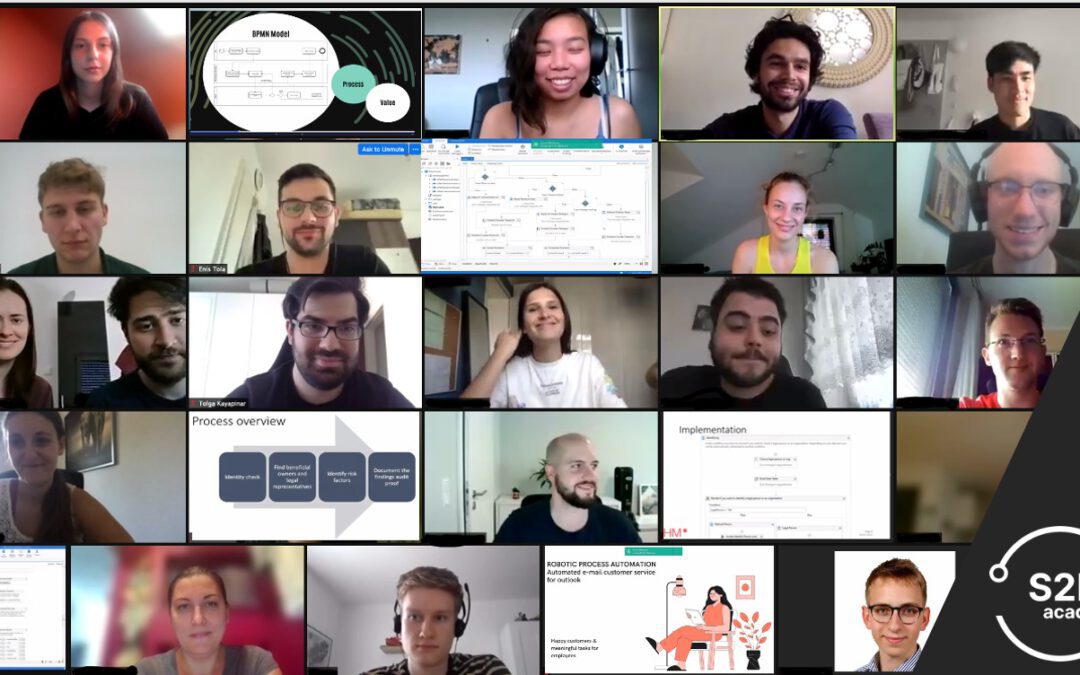
Robots already facilitate numerous routine processes such as the above. Therefore, this semester 24 students of the Faculty of Computer Science and Mathematics took the elective seminar of “Robotic Process Automation. They got this opportunity for the third time this year to find out which unsolved problems there are in this area in order to create automated process flows.

At the beginning there is a theoretical introduction to the subject. Relatively quickly, however, it gets down to the nitty-gritty: the students get to know the UiPath tool and form several small groups to develop solutions for realistic use cases. In the last online session of the semester, they then present their efforts in a pitch.

This pitch included explaining how they went about programming the robot and why the software-based implementation they chose made sense. But the purely technological part is not the only thing; the projects should also be able to hold their own in the real business environment as much as possible. That’s why the development of suitable business models including profitability calculations was another topic of the presentations.

The seminar project pitches

  1. Amazon Invoice Automation: Simplifies the proof of taxable purchases via Amazon through automated invoice issuance. By Nina Grabow, Philipp Keidler & Markus Vierheilig.
  2. Order Automation for Production Industry: Order process is error-prone, time-consuming and cost-intensive, automated solution solves these problems & simplifies documentation. By Oglou Oumout Giasar, Tolga Kayapinar & Teodora Pencheva.
  3. Payroll Automation: Payrolls are created automatically, as especially in small businesses these tasks are still performed manually one by one, which costs time and is prone to errors. By Dominik Moelter & Daniel Richter.
  4. Filter Bot: Automated invoice generation for wholesale, which lists different invoices & items clearly and automatically. By Enes Aksakal & Ganna Minakova.


  1. Immo Robo: See above scenario. By Barbara Demendi, Markus Kudela & Aron Szabo.
  2. Know-Your-Customer Check: Described in more detail below. By Marc Hennig, Lisa Kothgasser & Pia Lippert.
  3. Point-of-Sale Roboter: Similar to Team 2, Athanassios Fuqi, Manuel Genster & Susanne Moelter dedicated themselves to the automated ordering process, but in the retail of goods instead of the manufacturing industry.
  4. Dormatically: Automated verification of rental payment of student housing furnishings to make the process faster and less error-prone. By Mateo Rodic, Promwat Angsuratanawech & Enis Tola.
  5. Email Customer Support: See described below. By Doan Pham Yen Oanh, Paulina Fessl, Kerem Oeztuerk.

The practical introduction to UIPath allowed me to gain a solid overview of the topic of Robotic Process Automation. The team work was a great hands-on addition.

Marc Hennig, seminar participant & student of business informatics


What did the students accomplish?

The pitch of the student projects at the end of the seminar was exciting. For example, the team of Marc Hennig, Lisa Kothgasser and Pia Lippert chose the use case of companies that have to undergo an audit. These are required by law to provide, analyze and evaluate data about their business contacts in order to prevent fraud. Their “Know-Your-Customer” robot is designed to simplify this by automatically documenting and evaluating identity verification, and all other relevant data.

Jana Bulkin as lecturer as well as the IT specialist Francesco Menniti from the Munich branch of integrationWorks GmbH then evaluated the student concepts. The lecturer emphasized how high the general standard of all seminar projects was. The students were pleased with the theoretical knowledge, for which they were then able to find practical uses right away.

For example, Dominik Möltner and Daniel Richter developed an automated solution for payroll accounting, as this is a perfect example of recurring, rule-based and structured processes. All other use cases are also impressive. For example, there is the robot that helps with the automated inventory after a sales transaction in a department store or the chat bot that independently filters whether and how it can help users in customer support and, if in doubt, forwards the inquiry.

These are just four of the nine projects, whose quality is in no way inferior to those mentioned, but which would exceed the scope of this article. The fantastic results demonstrate once again that this is what hands-on teaching and learning should look like.

All these projects are great ideas that have the potential to make everyday work significantly easier. A success for all involved. If you would like to learn more about these topics at a seminar or workshop or already have concrete ideas about the processes to be automated, please do not hesitate to contact us – we will be happy to help you with the implementation and connect you with the appropriate experts.

We Reveal Why a Hackathon Is Worth a Try

We Reveal Why a Hackathon Is Worth a Try

Haven’t you heard of hackathons? The word is a combination of ‘hacking’ and ‘marathon’. However, it’s not about hacking data – it’s an event that classically runs for 48 hours. Software developers from various disciplines, as well as graphic designers, project managers and other technology experts, come together to solve a specific problem. The goal is to create a “running” software or hardware at the end of the event in which everyone involved was able to give their input.

Who would profit from a hackathon?

Schools

As a school you can actively address the topic of digitalization and integrate students into the ideation process or even assign them responsibility. Students may actually come to an initial decision here regarding their future career aspirations. It is important to adjust the scope and technical depth and to note that it might “only” be ideation processes with the support of design thinking, for example. This does not have to be a weekend project, but can also be offered in the form of a project group and held throughout the school year or during summer break as a purely optional event in a camp with an extended social program.

Universities & Colleges

Students get insights into the reality of work, practical experience, they can show skills under supervision and prove them to potential future employers. Universities and colleges that combine practice with theory create added value; as part of their elective courses, this can enhance the curriculum and introduce students to best practice combined with hands-on experience in projects for relevant key technologies. This is also possible as a weekend event or as an optional summer school offer for 1-2 weeks during the semester break.

Companies & Organizations

Issues are dealt with in an innovative way with a target orientation and concrete results. The idea here is that companies formulate relevant challenges, including the company-specific technical framework, and put them out to bid for a hackathon. This can be done purely in-house to encourage employees to actively help shape the future and change the organization, to deal with new technologies and thus see whether this could be a topic for professional development (internal job market).

However, it also makes sense to issue an external tender to universities, chambers of industry and commerce, or to the public at large, in order to gather ideas for issues and even for recruiting. Especially within a dual education this opens the possibility to extend it by a hackathon as a company-specific practical part to positively influence and incentivize motivation and knowledge building. Who knows – you might find a team or StartUp that fits the company, from which a kind of dynamic innovation hub can emerge.
6 advantages of hackathons

  1. Dedicated approach to a challenging problem → no distractions caused by daily business routine
  2. Experts from a wide variety of backgrounds work together → everyone knows exactly what is being worked on, no delay in communication channels
  3. Cooperation of employees who otherwise do not cooperate much → strengthening of the team spirit
  4. Understanding of the necessary roles in a team to develop a product and/or solution → better comprehension of the big picture
  5. Employees come into contact with previously unknown topics → broadening of personal knowledge
  6. Cooperation with e.g. universities can be used for recruiting and screening → early engagement of potential future job candidates

What is the relation between S2BConnected and hackathons?

concept hackathon

Hackathons are absolutely in line with our ‘Connected’ motto: we help you network for innovative solution finding. Because as we can see, all parties involved in the hackathon benefit from this event. For the planning and organization, however, you need some knowledge about the processes of such an endeavor.

In addition, it is advantageous to have good contacts to a wide variety of experts in order to be as diversified and specialized as possible. Through many years of practice in the software industry, we are able to build these networks and put them at the service of your progress.
© stories / Freepik

What is the procedure for a hackathon?

Pre- and post-event work must be done: among other things, the definition of the scope, the offer and the adaptation of the technological platform in advance as well as the post-event evaluation, the implementation of special trainings and the communication for the respective channels. We will be happy to assist you in this process. When it comes down to the nitty-gritty, the general process is as follows:


Holding a hackathon

  1. Define & communicate agenda
  2. Assign roles: keynote speaker, mentor and jury members
  3. Various agenda items:
    • Instructions
    • Bootcamp
    • Gathering in plenum
    • Motivation of the teams
    • Evaliation of the team efforts
    • Matching of a solution proposal
    • Communication to sponsors, customers and teams
  4. Recognize achievements, celebrate and general exchange, networking

Now, let’s say…

… you have a need to make your supply chains more transparent and traceable and are considering blockchain technology to do so. It is now worthwhile to hold a hackathon about this. We can initiate this for you, for example in cooperation with our partner MorpheusLabs Pte. There will then be something for everyone: those who don’t already have the skills can participate in workshops, there can be competitions in teams on specific use cases. This is how the ideation process starts and things get moving to create a first Minimum Viable Product (MVP).

Getting curious? Feel free to contact us for a non-committal consultation. We look forward to being innovative with you.

Agile product management – Follow the road of smart innovations

Agile product management – Follow the road of smart innovations

A solid product that meets their expectations and makes their lives easier is what your customers want. To ensure this, you should take an in-depth look at the different aspects of product management. The approach of agile product management follows a plan with different steps that aligns with your vision, yet is flexible to new customer requirements. With a clean methodology you will master this task. Because every innovation needs a framework. In this article, we will first introduce the steps to be taken and then present three practical examples that illustrate various key points of decision-making for an approach.

Creating a successful product step by step

Where customer, technology and business meet, it’s all about agile product management, as we describe it here. To maintain a balance within this triangle, you should define a framework that supports you in this endeavor:

  1. SELF-ANALYSIS: Take an in-depth look at your specific market segment, get to know your competitors and define your niche.
  2. CUSTOMER ANALYSIS: Get to know your customers. What challenges and problems do they face and what solutions would they like to see?
  3. PROBLEM ANALYSIS: This involves taking a closer look at the challenges faced by your customers and validating them. Various criteria can be evaluated for this purpose:
    • Root cause research: Ask questions, for example follow the 5 Why questions, to get to the source of a problem so that you can do more than just treat the symptoms.
    • Frequency: Find out the frequency with which your customers experience the problem in question.
    • Extent: Determine the proportion of your target market that regularly experiences the problem and is limited by it.
    • Measurability: Provide a sample calculation to quantify costs & benefits for your customers.
    • Actuality: Check your specific market segment for new developments and predicted trends.
  4. SOLUTION FINDING: To do this, develop your implementation plan and proceed using measurable criteria.
    • Ranking: Prioritize which problem needs to be solved most urgently and whose solution consequently has the greatest benefit. You make the decision by evaluating the customer benefits, the implementation effort, the profit opportunities as well as the required work effort/skills, etc.
    • Scheduling: Define milestones, a target date and create a detailed plan including estimated duration of the different steps for the implementation – this helps at the same time to further qualify the ideas and possibly adjust the scope.
    • Communication: Create a story for your customers and visualize it. To do this, define the end user, highlight his or her problem, describe the benefits of using your product, and know the requirements for high market acceptance.
  5. REALIZATION: Stick to your schedule and get active.
    • Most Viable Product: Create the MVP and validate its key features. Also collect user feedback to measure prediction accuracy and impact. Duration is about 1 – 2 months according to the Think Big – Start Small approach.
    • Marketing: Plan and set-up the different tools for customer interaction (sales, support, customer targeting). Duration is about 2 – 4 months.
    • (Re-)Launch: Write announcements, identify key customers, identify support bottlenecks. How are customers using your product?
    • Statistics: Even with the first stage of the launch, it is important to collect data. What feedback do you get from your customers? Compile criteria for Key Performance Indicators (KPIs) to adjust functional requirements, make improvements and react flexibly to potential changes in the market.
  6. REVISION: Review progress regularly against measurable data to make improvements.
    • Checkpoints: Track KPIs to review previously established measurable indicators based on data. Record and visualize results.
    • Deficiencies: Plan improvements based on forecast accuracy, data on user engagement and feedback, and the number of critical defects.

Agile product management in practice

The design of agile product management in large companies is always a challenge, especially if the planning and cost aspects are mainly based on a standard approach. For example, when mean value, portfolio and project evaluations are evaluated about once a year and assigned to the respective clusters.

agile product management budget planning

The budget allocated to innovation is usually based on the costs required for maintenance and ongoing operations. In order to keep the gap between the budget available for innovation on the one hand and that for ongoing operations on the other small, consolidation and housekeeping measures are a prerequisite. For example, it is important to take into account business requirements such as the necessary adjustments, which the IT department must implement according to both a top-down and bottom-up approach. Corresponding scope must be planned at an early stage in order to initiate essential changes directly.

This avoids having to postpone projects or down-prioritize what has already been planned. Agile product management should be supplemented by clean portfolio and project planning.
© osaba / Freepik

Food for thought: If you are pursuing plans that have a major impact on your end product, you need a clear vision and mission in order to be able to start stakeholder alignment as early as possible.

For a product that only serves a specific area or function, agile product management is somewhat easier than for products that define the organization on a global level, where product ownership is not on the business but on the IT side. This makes sense, as these services are referred to as platforms and infrastructure and are intended to create synergies of a cross-divisional nature, which does not necessarily make planning easier with a divisional top-down planning process.

On the other hand, if the impact is so significant that more or less your entire team needs to be involved, changes that impact actual end-users will be difficult to reconcile with your platform alignment. The effort involves the challenging balancing of your stakeholders who are already using your platform, their new requirements and on top of that, potential new customers who want to be served at the same time.

1. Example: Agile product management for enterprise-wide services

Depending on the service design, agile product management can be influenced by various factors that need to be considered for planning. As a rule, services combine a large number of products and technologies, all of which are subject to their own lifecycle. If, in addition, there is a general change of architecture for one of the core components, the question of cost and benefit arises, as this may also entail massive migration efforts.

Here it makes sense for you to consider whether a general platform change could possibly be more cost-effective and also more innovative. In this case, you need to arrange an early information of the provider about these major implications and a good cooperation in order to allocate the necessary budget and to proactively address its impact on the overall project and portfolio planning as well. Take this time to generate stakeholder awareness. Once the budget is allocated to the service owner, the project for this change can begin.

Big bang approaches may not be effective here; an agile approach to rolling out the new architecture in this case should take the approach of moving forward process by process if the service is connected to multiple E2E processes that impact B2C satisfaction. The platform itself and the preparation of the backend then follow a rather classic rollout approach. This results in an “agile waterfall approach” – hybrid approaches are often the better concepts for lifecycle management of critical enterprise services.

The key is not to prioritize what’s on your schedule, but to schedule your priorities.

Stephen R. Covey, author and management expert


2. Example: Agile product management E2E for an external IT provider with overarching cloud philosophy

Agile product management from the developer’s point of view should meet some requirements:

  • Pursue a “DevOps” philosophy, or ensure that at least some self-managed services are in place from the product owner’s perspective.
  • Sufficient free resources should be available in the infrastructure and it should be scaled horizontally so that innovations are not slowed down by shortages from the start.
  • An effect-based allocation at the application level makes system owners responsible for costs in order to act conscientiously with the resources made available.
  • Medium resource pools should be available with established housekeeping services.

Once these basic pillars are established, the basis for agile development is created. Another point is the awareness of responsibility and acceptance that errors are possible and that an internal service culture with service responsibility should be established. Reviews by internal auditors and security should add value rather than create fear when a problem is found. A service catalog within the organization can help.

It is worthwhile to have a central architecture team to take care of the strategy, assisting with product portfolio management through appropriate processes. Avoid a hero attitude of (full-stack) developers because in complex organizations nobody can know everything and besides that, it is harmful for the team spirit – at least to our thinking.

Make sure that communication and collaboration platforms are in place to support the agile product management. This gives customers the opportunity to make requests and product management is able to communicate the new features. The entire organization should operate as a team with clearly defined responsibilities. It might also be worth thinking about the Lean approach here, as learning is also important in this approach. Regarding this, we have another interesting article: This is how you succeed in the CUCA World.

3. Example: Product management in an IT consulting company for tech-savvy startups (first step into product ownership)

Guiding IT consultants into a product owner mindset is a challenging task. Often they know the philosophy of agile product development, but they don’t fully understand project management (what needs to be done by when). This is because the majority of IT consultants are used to receiving instructions from the outside. They are hired to perform the implementation according to standards that may have already been set by the client. During the testing and release of the product, they are usually no longer involved and will ultimately not come into contact with the customers.

This problem has nothing to do with their personal attitude, but is rather in the nature of the business. Consultants look for the solution that seems best for them, possibly without thinking about maintenance and cost effects as well as skill and knowledge transfer. Therefore, the essential attitude of taking full responsibility from the product owner’s point of view might not yet be fully present. It is completely logical that this will not happen overnight. Therefore, it is quite possible that management will have to make a decision. However, such issues are usually not part of the agile product development approach, even though this is a parameter to manage a product from a 360-degree perspective.

It might be sensible to follow the lean approach here, where failure is allowed and understood as a learning opportunity rather than a defeat. The entire organization, including management and leadership style, should be adapted to this and seek support if the change from a pure IT consulting company to a company with product ownership is to be made.

Your product is your flagship. How it works and what appeal it has will largely determine the success of your business. These criteria can be influenced in advance by a thoroughly planned approach and the diversity of your team. Become aware of what you want to achieve, which adjusting screws are necessary for it and which approach is best suited for it. Products are created by people and are supported by technology – PPT, these are the three most important parameters for successful product development.